
Happiness Across Cultures: Why Feeling Good Is Not the Same Everywhere
Culture can shape what happiness means, how people search for it and what supports well-being.


Hook
Everyone wants to be happy, but not everyone defines happiness in the same way. For one person, happiness may mean freedom and personal choice. For another, it may mean stability, family or feeling safe in a community. This study shows that happiness is not only personal. It is also cultural.
Why this matters
Money and living conditions influence well-being, but they do not explain everything. Two countries can have similar income levels and still show different happiness scores. That means other factors are at work. Culture gives people ideas about what a good life should look like. It shapes expectations, goals and the way people judge their own life.
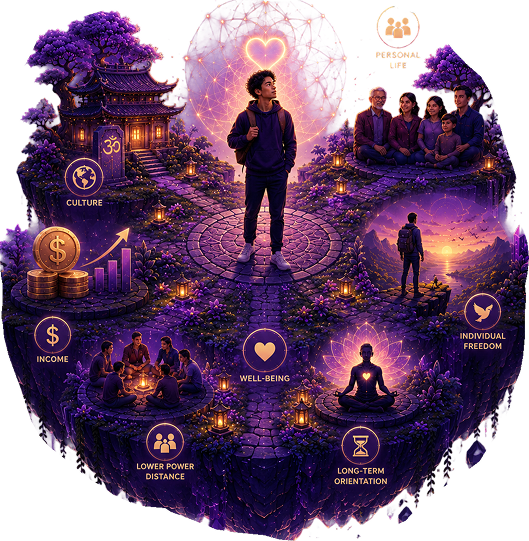
The study uses Hofstede's cultural dimensions to examine this connection. These dimensions include power distance, collectivism versus individualism and long-term orientation. They help explain why some societies value freedom and autonomy, while others focus more on stability, hierarchy, patience or tradition.
What the study looked at
The study highlights that cultural values are associated with happiness even after controlling for income and demographics. In simple words: culture still matters even when researchers consider money, age and other personal factors. Well-being is not only about what people have, but also about what they believe, expect and value.


Finding 1: lower power distance, higher happiness
Countries with lower acceptance of inequality reported higher happiness. Power distance describes how much people accept unequal power between groups, leaders and ordinary people. When power distance is low, people may feel more equal, more respected and more able to influence their own lives.
This finding suggests that fairness and autonomy support well-being. When people feel that their voice matters and that authority is not completely out of reach, life can feel more manageable. This does not mean every low power distance society is automatically happy, but it shows a meaningful pattern.
Finding 2: lower collectivism, higher happiness at country level
At the country level, societies with stronger individual freedom showed higher life satisfaction. This does not mean collectivistic cultures are unhappy. It means that, in this analysis, autonomy and personal choice were linked to higher national happiness scores.
This makes sense in many modern contexts. Being able to choose your path, express your identity and make personal decisions can support well-being. But the finding also needs nuance. In collectivistic cultures, happiness may be experienced more through family harmony, social support and fulfilling responsibilities. The study shows a pattern, not a full explanation of every person.
Finding 3: long-term orientation helps individuals
This study is useful because it shows that student life is not universal. The same age group can have very different priorities depending on culture. One student may see nightlife as normal social bonding, while another may value family routines, caution or tradition more strongly. Neither lifestyle is automatically better. They reflect different social environments.
It also helps avoid stereotypes. Culture can explain patterns, but it does not define every individual. There are healthy Thai students, conservative Australian students, trendy students in both places and people who do not fit any category perfectly. The point is not to label people, but to understand patterns.

Why the results are complex
One important lesson is that culture does not work in a simple one-size-fits-all way. Some patterns appear at country level, while others appear at the individual level. A country may have one cultural profile, but individuals inside that country can still think differently. People are shaped by culture, but they are not copies of it.
Main takeaway
Happiness is influenced by income and personal life, but also by culture. Lower power distance and long-term orientation are linked to higher well-being in important ways, while individual freedom appears strongly connected to happiness at the country level. The bigger message is simple: well-being is not only about feeling good. It is about the values that make life feel meaningful.
Get in Touch
We are here to help.
Send us a message and we’ll get back to you soon.


